
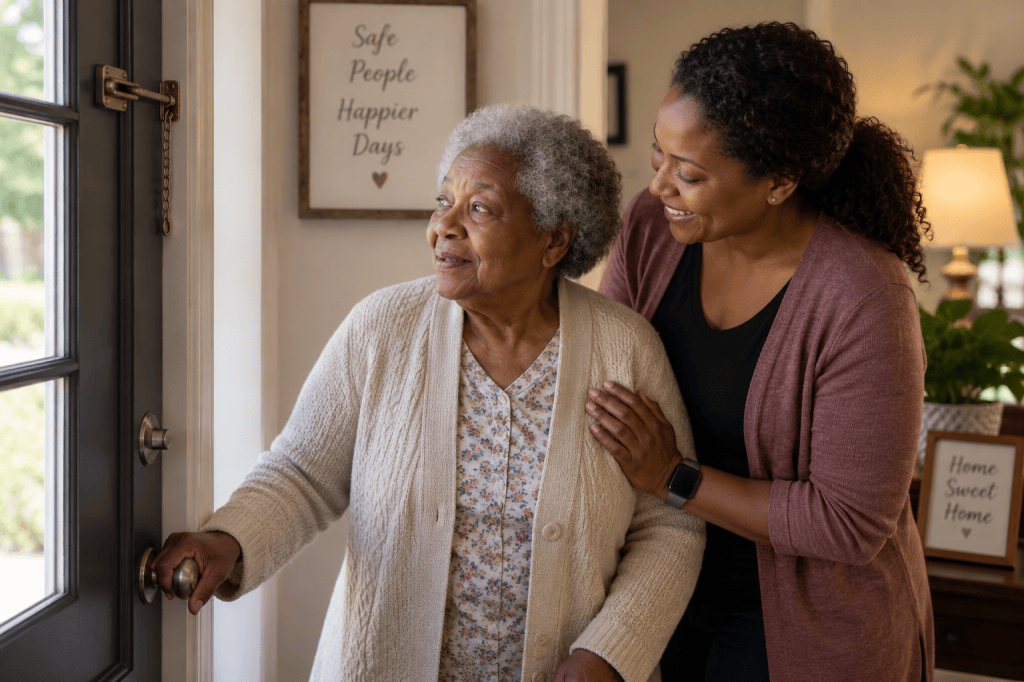
If you care for someone with dementia who may leave the house alone, one lock or one tracking device may not be enough.
With my mother, I use layers of protection. First, I make it difficult for her to leave the house unnoticed. Then I make sure I know if an outside door opens. And if she somehow gets past those protections, I have another way to help locate her.
The goal is not to stop Mom from moving around. She walks freely throughout our house all day. The goal is to make it safe for her to do that.
1. Find a Door Setup That Works for Your Person and Your Home
My mother is small, so one thing that works well in our house is an additional security latch placed high on the inside of an exterior door. I also use two small, strong clips that add another step she does not know how to undo. We can open it easily.
That exact setup will not work for everyone. A taller person may be able to reach the same latch. Someone else may quickly figure out the clips. Another family might find that a properly installed folding barrier or gate works better because the caregiver can open or fold it easily while the person with dementia does not know how to operate it.
The particular device is not important. The person is.
Look at the person you are caring for and the way your home is arranged. What can they reach? What can they figure out? What do they normally do when they want to leave? Look for a simple physical barrier that is difficult for that person to operate but easy for the caregiver to use.
There are many different secondary locks, latches, and barriers available. You do not necessarily need something marketed specifically for dementia care.
Whatever you use, however, it must be appropriate for your home and must not create another danger. Additional locks, latches, gates, or barriers can interfere with emergency escape if they are poorly chosen or installed. Make sure everyone who needs to exit the home can do so quickly in an emergency, and follow applicable fire and building-safety requirements. If you are unsure whether a setup is safe, get advice from a qualified professional rather than copying someone else’s arrangement.
2. Look for Simple Habits You Can Use
I also keep Mom’s shoes out of sight.
This works for one very simple reason: my mother will not go outside without shoes. If she doesn’t see them, she usually doesn’t look for them.
That would be completely useless for a person who would happily walk outside barefoot.
This is why knowing the person matters as much as any piece of equipment. Instead of constantly telling Mom not to leave, I look at what she actually does and change the environment around it.
3. Make Sure You Know When an Outside Door Opens
Physical barriers are only the first layer in our house.
During the day, our security system makes a chime whenever an outside door opens. Mom walks around the entire house all day and opens doors constantly. She may open the same door over and over. I don’t stop her.
If an outside door opens, I hear it.
At night, I arm our home security system before we go to bed. If an outside door opens, the alarm goes off. That means I don’t have to stay half-awake all night listening for a door. I can sleep.
We also have cameras, but I consider those backup. I would rather prevent an unnoticed exit or know when a door opens than discover later on a camera that Mom has already left.
4. Have a Way to Help Locate Them Anyway
Even with those precautions, I still plan for the possibility that Mom could somehow get out.
I use Apple AirTags as an additional backup. At home, I usually attach one to the back of Mom’s clothing with a simple badge-style clip, similar to the kind used for a work ID. I place it where she normally doesn’t notice or remove it.
When we go out, I often remove that one because I have another AirTag in her shoe. I use an insole made with a recessed space for an AirTag, so it sits inside the insole rather than protruding under her foot.
When we come home, the shoes are put away and I clip the other AirTag back onto her clothing.
If Mom somehow gets away from us, I can check the Find My app and use the AirTag’s available location information to help find her. An AirTag is not a standalone GPS tracker with its own cellular connection, and its ability to update location depends on Apple’s Find My network. I would never rely on it as the only protection against wandering.
It is simply another backup if the earlier layers fail.
5. Make It Routine
None of this feels complicated in our house anymore because it is simply part of daily life.
The door protection is already there. Mom’s shoes stay out of sight when we are home. I hear the door chime during the day. The security system is armed at night. At home, I usually have an AirTag clipped to Mom’s clothing. When we go out, there is one in her shoe.
Once these things become routine, I don’t have to spend my day thinking about wandering prevention.
More importantly, I don’t have to spend my day following Mom around.
The Goal Is Safe Freedom
Mom walks all over our house throughout the day. She looks around, goes from room to room, and opens doors. Sometimes she opens the same door a hundred times.
I let her.
I don’t want to spend the day saying, “Don’t go there,” “Stop opening that,” or “Come sit down.” I would rather change the dangerous parts of the environment and let her move around.
That is what safe freedom means in our house.
The goal is not to stop Mom from moving. The goal is to make it safe for her to move freely.
The physical barriers help prevent an unnoticed exit. The chime tells me when an outside door opens. The nighttime alarm lets me sleep. The AirTag gives me another way to help locate her if the other protections fail.
After more than 12 years of caring for my mother with dementia at home, I have learned that I don’t need one perfect solution. I need practical layers that work for my mother, in our home, without unnecessarily taking away her freedom.
Your person and your home may be completely different. Use these examples as ideas, not instructions for a particular lock, gate, alarm, or tracking device. Any safety setup should fit the person’s abilities, the home, and emergency-exit requirements.
Related Articles
What to Do When a Person With Dementia Keeps Saying “I Want to Go Home”
Caring for a Parent With Dementia at Home: What 12+ Years With My Mom Taught Me
 Dementia Family Care
Leave a comment