
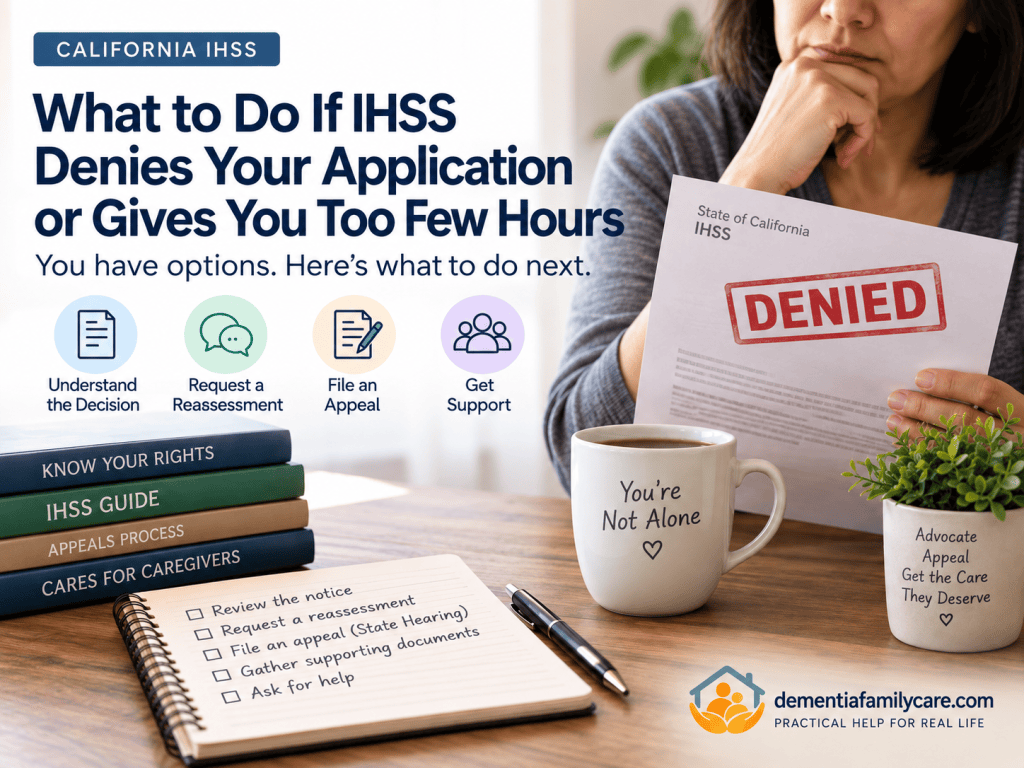
Receiving an IHSS Notice of Action that denies your application or gives you fewer hours than you believe are necessary can be discouraging.
But the county’s first decision is not necessarily the end of the process.
If you disagree with an IHSS decision, you can request a State Hearing and have the decision reviewed. In California, you generally have 90 days to request a hearing after a county action.
Before you appeal, however, it helps to understand exactly what the county decided and where you disagree with the assessment.
Start With Your Notice of Action
Your Notice of Action (NOA) tells you what IHSS approved, denied, reduced, or changed.
If your application was denied, look for the reason given.
If you were approved but believe you received too few hours, do not look only at the total monthly hours. Look at the individual services and how much time was authorized for each one.
Depending on the person’s needs, IHSS services may include assistance with things such as:
- Bathing and grooming
- Dressing
- Bowel and bladder care
- Meal preparation and cleanup
- Eating
- Mobility
- Housework and laundry
- Shopping and errands
- Accompaniment to medical appointments
For a person with dementia, cognitive limitations may also affect how safely and independently these activities can be performed.
California’s IHSS assessment process considers physical, cognitive, and emotional functioning. Mental functioning is evaluated in areas including memory, orientation, and judgment.
The first step is to identify exactly what part of the county’s decision you believe does not reflect the person’s actual needs.
Describe What Actually Happens at Home
With dementia, what someone can physically do and what they can safely and reliably do without assistance may be very different.
For example, there is a difference between:
“She can go to the bathroom.”
and:
“She can physically walk to the bathroom, but sometimes she cannot find it without help.”
There is also a difference between:
“He can take his medication.”
and:
“He can swallow his medication, but he cannot reliably remember whether he has already taken it.”
Someone may be physically capable of preparing food but no longer be able to use the stove safely. Someone may be able to dress but need reminders, guidance, or help choosing appropriate clothing.
California’s IHSS assessment rules recognize different levels of functioning, including situations in which a person can physically perform a task but requires verbal assistance such as reminding, guidance, or encouragement.
When you disagree with an IHSS decision, describe the assistance the person actually needs in everyday life.
Do not describe only the diagnosis. Describe the care.
Request a State Hearing
If you disagree with the county’s IHSS decision, you can request a State Hearing.
In California, you generally have 90 days to request one. Your Notice of Action includes information about your hearing rights and how to request a hearing.
You can request a hearing through the California Department of Social Services State Hearings Division.
Request a California State Hearing
You do not need to write a complicated legal argument to request a hearing.
You can state clearly what you disagree with. For example:
“I disagree with the number of IHSS hours authorized because the assessment does not reflect the assistance the recipient needs to safely perform daily activities.”
If particular services were denied or given too little time, identify those services.
Gather Information That Supports the Care Needs
Once you request a hearing, begin gathering information that supports the part of the decision you are challenging.
Depending on the issue, useful information may include:
- Medical records or documentation from a doctor or other health professional
- Notes describing the assistance provided each day
- Specific examples of problems or safety concerns
- A list of tasks the person cannot complete safely or consistently without help
- Records showing changes in the person’s condition or abilities
For dementia care, specific examples can be particularly useful.
Instead of writing only:
“She has dementia and needs supervision.”
describe what happens.
For example:
“She sometimes leaves the house without understanding where she is going.”
“She cannot reliably remember whether she has eaten.”
“She can physically use the stove but cannot use it safely without someone present.”
“She needs reminders and guidance to complete bathing and dressing.”
The point is not to make the situation sound worse than it is.
It is to make sure the person’s actual needs are visible.
Go Service by Service
If you were approved for IHSS but believe the hours are too low, it can help to review the decision one service at a time.
Ask:
What assistance does the person need for this task?
Can they perform it safely without another person?
Do they need physical help?
Do they need reminding, guidance, or encouragement?
How often is the assistance needed?
How much of the task is the caregiver actually doing?
This can make it easier to identify where the county’s assessment differs from what is happening at home.
It also gives you specific issues to explain at the hearing instead of simply arguing that the total number of hours is too low.
Prepare for the Hearing
Before the hearing, organize your information around the parts of the IHSS decision you disagree with.
You do not need to prove that the person cannot do anything independently.
The important question is what assistance they actually need.
With dementia, that may include situations in which someone still has the physical ability to perform a task but has difficulty with memory, orientation, judgment, or completing the task safely.
Keep your explanation simple and specific.
Instead of:
“My mother needs a lot of help.”
explain:
“My mother can walk independently, but she cannot safely leave the house alone because she becomes disoriented and cannot find her way back.”
Instead of:
“My father cannot manage his medication.”
explain:
“My father can physically take the pills, but he cannot remember which medication to take or whether he has already taken it.”
Specific examples help explain what the assistance actually involves.
If Your Existing IHSS Hours Are Being Reduced or Stopped
If you already receive IHSS and the county sends a Notice of Action reducing or stopping your services, look at the effective date immediately.
This is important because the deadline for requesting a hearing and the deadline for keeping existing benefits in place while an appeal is pending are not necessarily the same.
California hearing-rights information explains that, in certain circumstances, requesting a hearing before the county action takes effect can allow existing services to continue while the hearing is pending.
So if your current IHSS services are being reduced or stopped, do not simply assume you have plenty of time because of the general 90-day hearing period.
Read the Notice of Action as soon as you receive it.
You Can Ask for Help
You can represent yourself at a State Hearing, but you do not have to handle everything alone.
California allows you to have an authorized representative. This can be a relative, friend, attorney, legal-services representative, or another person you choose.
You may also ask the county for a conference to discuss the decision. A county conference and a State Hearing are different processes, and asking for a conference does not replace your hearing rights.
If you are trying to resolve the issue with the county, continue to pay attention to the State Hearing deadline.
The Most Important Thing to Remember
An IHSS appeal is not simply about asking for “more hours.”
It is about showing where the assessment does not reflect the assistance the person actually needs.
For someone with dementia, do not focus only on what they can physically do.
Think about what they can do safely, consistently, and without another person’s help, reminders, or guidance.
Start with the Notice of Action. Identify the services or hours you disagree with. Gather information that supports those needs. Then explain them as clearly and specifically as you can.
The goal is not to make the person appear more disabled than they are.
It is to make sure the care they actually need is not left invisible.
 Dementia Family Care
Leave a comment