If you are caring for a parent with dementia at home in California, In-Home Supportive Services (IHSS) may help pay for some of the care they need at home.
IHSS is a California program for eligible older adults and people with disabilities who need help to remain safely in their own homes.
If you are already caring for your parent, you may also be able to become their paid IHSS provider.
Here is how to get started.
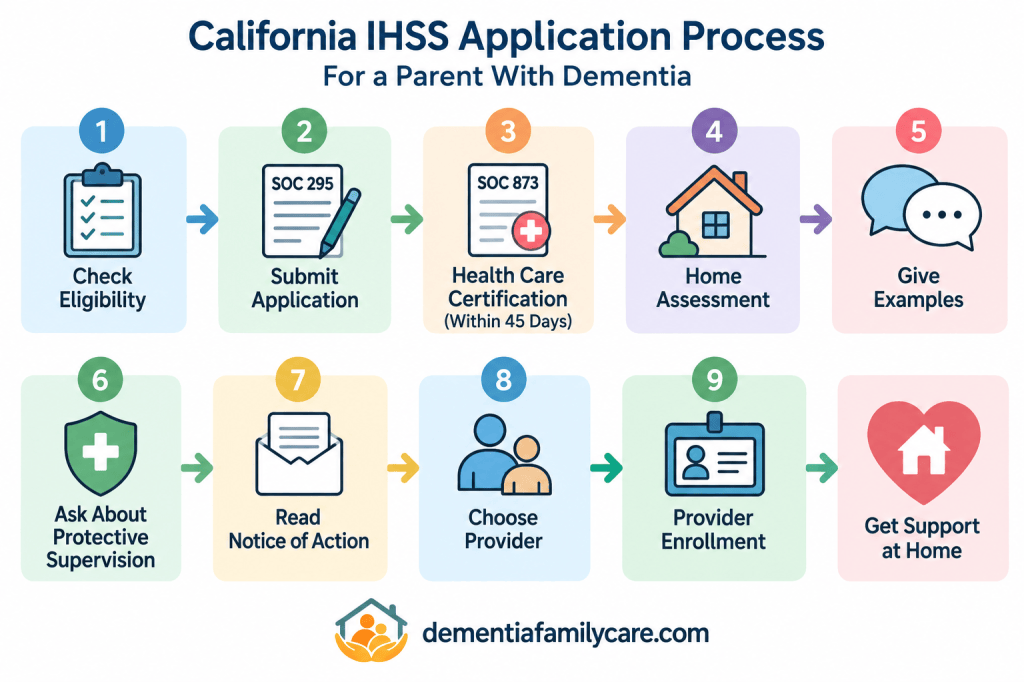
Step 1: Check the Basic Requirements
To qualify for IHSS, your parent must:
• Be a California resident
• Have a Medi-Cal eligibility determination
• Live at home or in a residence of their own choosing
• Submit a completed Health Care Certification
Hospitals, long-term care facilities, and licensed community care facilities are not considered the person’s own home for IHSS purposes.
Dementia does not automatically determine how many IHSS hours someone will receive. The county looks at what help the person actually needs to remain safely at home.
Step 2: Apply Through Your County IHSS Office
IHSS applications are handled by the county where your parent lives.
Complete the SOC 295 — Application for In-Home Supportive Services and submit it to your county IHSS office.
Keep a copy of everything you submit. You may need it later.
Step 3: Complete the Health Care Certification
Your parent will also need a Health Care Certification (SOC 873) completed by a licensed health care professional. The county must receive the certification before IHSS services can be authorized.
The completed certification generally must be returned within 45 calendar days from the date the county requests it. You are responsible for making sure it is completed and returned on time, so follow up with the healthcare provider if necessary. California regulations provide limited exceptions and extensions in certain circumstances.
With dementia, make sure the healthcare professional understands the person’s cognitive problems as well as their physical condition.
Someone may still be able to walk, eat, or dress themselves physically but have serious problems with memory, judgment, orientation, or safety.
Step 4: Prepare for the Home Assessment
A county social worker will visit your parent’s home to determine what help they need and how many IHSS hours may be authorized.
Before the visit, write down what you actually do for your parent each day, such as:
• Bathing and personal care
• Dressing
• Toileting and incontinence care
• Preparing meals
• Laundry and housecleaning
• Grocery shopping
• Medication-related assistance
• Getting to medical appointments
• Mobility assistance
• Supervision related to cognitive impairment
The assessment can include information from the applicant as well as family, friends, physicians, and other licensed healthcare professionals.
With dementia, don’t think only about what your parent can physically do.
Think about what they can do safely without your help.
Don’t exaggerate, but don’t minimize either. When you do the same things every day, it’s easy to forget how much help you’re actually providing.
Step 5: Give Specific Examples
A person with dementia may appear much more independent during a short home visit than they really are.
Instead of simply saying:
“My mother has dementia.”
Explain what actually happens.
For example:
“She can walk to the bathroom, but sometimes she cannot find it without help.”
“She can hold her medication, but I have to stay with her to make sure she actually takes it.”
“She can eat by herself, but I prepare her meals because she can no longer safely cook.”
Specific examples give the social worker a much clearer picture of the care your parent actually needs.
Step 6: Ask About Protective Supervision if Needed
Some people with dementia may qualify for Protective Supervision when cognitive impairment creates a need for supervision to help prevent injury, hazard, or accident.
It is not automatically available because someone has dementia. The person’s individual needs and circumstances are assessed. California also has specific forms and assessment requirements for Protective Supervision.
If your parent wanders, turns on appliances unsafely, leaves the house without understanding the danger, or has similar unsafe behaviors, tell the social worker what actually happens.
Protective Supervision has its own rules and documentation requirements, so I’ll explain it in a separate article.
Step 7: Read the Notice of Action Carefully
After the assessment, the county will notify you whether IHSS was approved or denied.
If approved, the notice will tell you which services were authorized and how many hours per month were approved. If denied, you will be told the reason.
Don’t look only at the total number of hours.
Check which services were approved and how much time was authorized for each one.
If the application is denied or you believe your parent was given too few hours, you can appeal. I’ll explain that process separately.
Step 8: Choose a Provider
If your parent is approved for IHSS, they will need a provider to perform the authorized services.
If you are already caring for your parent, you may be able to become their IHSS provider.
Being approved for IHSS and becoming an IHSS provider are two separate processes. A provider cannot receive IHSS payment until the required provider enrollment process has been completed.
Step 9: Enroll as an IHSS Provider
To become an IHSS provider, California requires you to:
• Attend a county IHSS Provider Orientation
• Complete the SOC 426 Provider Enrollment Form
• Complete the SOC 846 Provider Enrollment Agreement
• Be fingerprinted and complete a California Department of Justice criminal background check
Contact your county IHSS office or Public Authority to begin the provider enrollment process.
How to Become an IHSS Provider
Once you are enrolled and connected to your parent’s IHSS case, you can be paid for the services and hours that IHSS has authorized.
One Thing to Remember With Dementia
When you apply, don’t describe only the diagnosis.
Describe the care.
If you remind your parent to eat, say that.
If you prepare every meal because cooking is no longer safe, say that.
If you take them to the bathroom, help with bathing, watch their medication, redirect them when they try to leave, or supervise them because they don’t recognize danger, explain it.
Family caregivers do these things so often that eventually they just feel like part of the day.
But when you apply for help, don’t leave that work invisible.
Official California IHSS Resources
California IHSS — Official Program Information
How to Become an IHSS Provider
This article provides general information about California’s IHSS program. Program rules and procedures can change, and eligibility and authorized services depend on each person’s circumstances. Contact your county IHSS office about your individual case.
 Dementia Family Care
Leave a comment